Talk by Molly Scott Cato to European Movement in Wandsworth & Merton
Omnibus Theatre, London SW4 11 February 2026
I want to share with you my real sense of pride in what it means to be European and in our values. And I don’t think we do this often enough. I think we’ve been browbeaten and battered down. Not just in the UK, but across our continent. And so what I’m going to hope to do is inspire you with pride and a sense of history and a real sense that you want to go out and just feel great about being European.
And how that impacts on what we’re doing and how we’re campaigning as the European Movement.
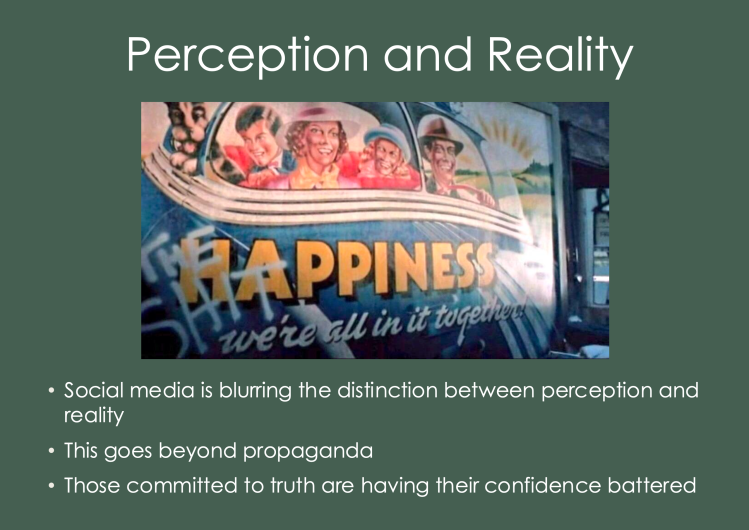
I love this image from the film Brazil. You’re being told that your life is great. You’re being told that you’ve never been happier. But the reality behind that is that we’re really struggling in quite a few different ways. And I think it’s really important when whenever you’re campaigning about anything, that you face the reality of what it means to live in this age of social media, because actually holding onto what’s true and holding onto what you believe in, is like a daily battle if you have any involvement in social media or indeed even with mainstream media these days.
To me, this goes beyond what we used to think of as conventional propaganda because what’s happening now is people are deliberately creating an artificial view of reality and trying to impose that on you. And people who are committed to truth are really having our confidence battered at the moment. And so I think it’s important that we acknowledge that, but we don’t in any way limit our commitment to truth.
Now, I’m sorry to have to share this guy with you this evening. Yeah, see, the pantomime villain of the evening: this is JD Vance. He’s like a charisma-free zone, isn’t he?
I’m going to talk about him, and this is specifically about his speech at the Munich Security Conference, which I think was so shocking, but it was also very intentional, and its intention was to batter and undermine our confidence as a continent, as people who feel proud of Europe. The intention was only to serve the fascists who are on the rise in Europe and to batter and undermine people like us who believe in the strength of a shared vision of what Europe’s all about. He also, as you probably noticed, focused very strongly on this idea about free speech, free speech as an absolute right.
There was a Radio 4 discussion recently (In Our Time) about how the French and the American were developing constitutional protection of free speech in parallel. And actually, the French were a little bit behind the Americans, and the French worked out actually absolute free speech can be quite problematic in terms of other values. Like democratic values, like commitment to truth, like not having what we would now call hate speech. But the Americans had got out there first and they already had that in their Bill of Rights. And now you can see the consequences of that because absolute free speech is damaging, and in European legislation, we do limit it in various ways and intentionally so, and rightfully so, I think.
One of the things JD Vance said, not in that speech, but elsewhere, is if American democracy can survive ten years of Greta Thunberg scolding, you guys can survive a few months of Elon Musk, which deliberately obfuscates the power imbalances you’re talking about there. You’re talking about a 16-year old girl, probably 20 by now, who is challenging entrenched power systems, compared to the richest, and one of the most powerful men in the world, a global oligarch. And that is typical of the deliberate distraction and misdirection that propagandists like Vance engage in. And his purpose here, as I’ve already said, but this is important, is to undermine our confidence. And my response to that is don’t get mad, get proud. I mean, I know it’s impossible to not get mad at JD Vance. But anyway, once you’ve got mad, move on and celebrate European values, and that’s what I’m going to try and encourage you to do this evening.
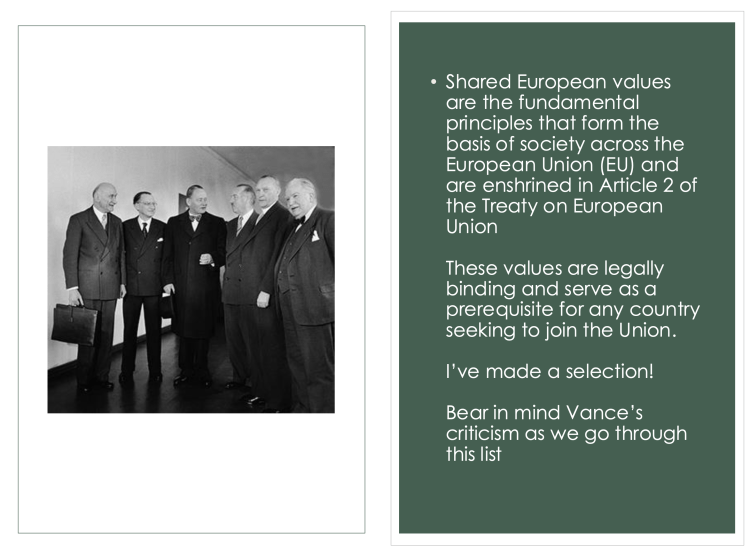
So, these are the guys that were responsible for setting up the European Union. We don’t celebrate our founding fathers very much. It does sort of depress and annoy me that they are all men, but I guess that was just how the world was at that time. But having said that, I was elected as an MEP. I was very embarrassed. I’m getting to Brussels to realise how little I knew about the European Union, its history and institutions because I only had a PPE degree here in the UK. So what are you going to learn about European politics? Not much. I did actually study West European politics, but nothing about the European Union, and especially not that sort of celebration of its history and its establishment and its purpose that you would certainly get if you studied, if you were just in school, actually, in the US, this is something that we, you know, we urgently need to change now. Never mind when we’re members of the EU again.
Anyway, I did learn about these founding fathers and about the shared European values, which are fundamental principles, as it says, which form the basis of society across the European Union, and they’re enshrined in Article 2 of the Treaty on the European Union. They are legally binding values, in as much as they can be implemented, and they serve as a prerequisite for any country seeking to join the Union.
Now, as we’re going to go through and look at these values, it’s going to become obvious that we don’t always live up to them. But nonetheless, I think it’s important that we see them as those fundamental and important values that we have committed ourselves to as Europeans. And I think you see in this country, that, once you leave those institutions and frameworks you can see an undermining of the values that the European Union requires us to live up to.
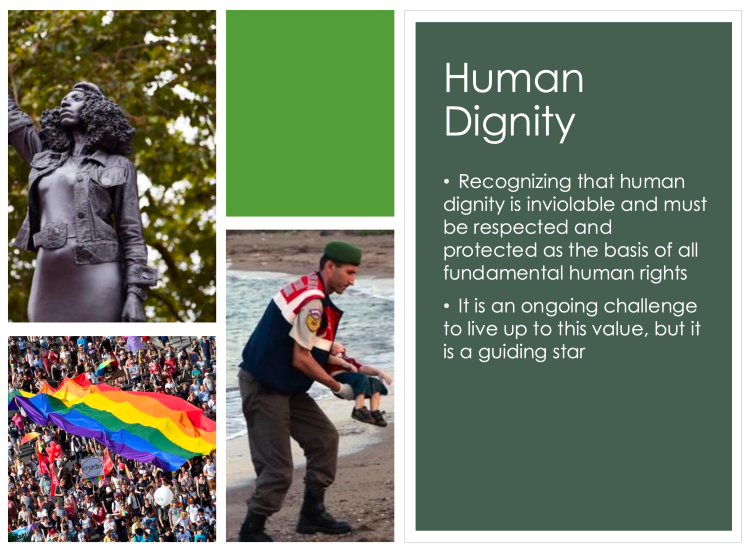
So top of the list comes human dignity. This is a really important value. It’s not something you can really write down in law. I don’t think. How could you explain what it means to respect somebody’s human dignity? But we are required to recognise that it’s inviolable and must be protected and respected as the basis of all human rights. Now as I say here, it’s an ongoing challenge, I think, to live up to this value. And it operates as a sort of guiding star, as a sort of objective that we seek to follow, even though we might not always live up to it. And we haven’t always lived up to it, particularly successfully, in recent years. And obviously part of what’s happening on the far right is an attempt to undermine exactly this vital European value.
The statue is the one made to replace the statue of Edward Colston that was brought down in Bristol. That was a momentous and great day, having grown up in Bath, just 12 miles from Bristol. So delighted to see that statue finally come down because it was an affront to the human dignity of every black person and every mixed-race person in Bristol, that they had to walk past right in the middle of Bristol, a statue of a slave trader, every day of their lives. And so, to me, that was a great movement forward for human dignity when that statue was removed. At the bottom there, you can see the importance of gay rights, which is respect for human individuality and dignity that’s grown up during my lifetime. And the other image there is to just say, there are times when we really fail here. And I think in terms of migration and especially the way we treat refugees, and the way we pulled up drawbridges, and are refusing to give everybody across the world a fair chance of a good life, is a demonstration of how we’re failing to live up.
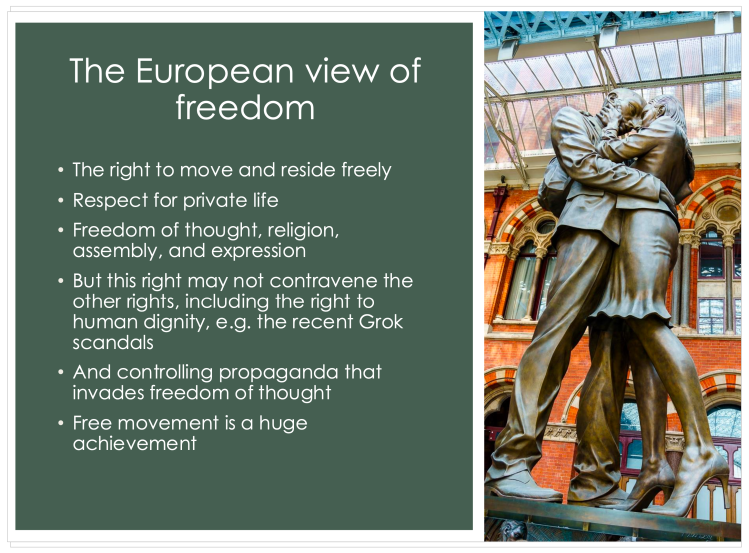
So, the second principle is all about freedom. It’s so important, the European view of freedom. And obviously the freedom to move and to live in any European society is a crucial part of this. It just astonished me after Brexit happened, that the conservative politicians were actually boasting about the fact that they removed our right to free movement, which was one of the greatest rights we had as members of the European movement. And it acknowledged the fact that actually we do share a society. We might fall in love with somebody who doesn’t live in the same European country that we do. And obviously this shouldn’t really just be limited to the EU, but that’s a right we’ve all lost, the right to travel freely, the right to form relationships, to work in other European countries. There’s also the respect for private life. And freedom of thought, religion, assembly, and expression.
But it’s important that we say that these rights should not be able to contravene other rights. So your freedom cannot contravene, for example, other people’s right to human dignity, and there I think we see the conflict with this sort of what they call free speech absolutism. And an example is, you know, somebody’s right to go into their social media account and take the clothes off a famous woman, does not, it cannot, contravene that person’s right to human dignity.
And this is where I think European commitment arrives, is superior to what’s happening in the US and our rights are being interpreted there. And again, also, we have the right to control propaganda. And one of the things I think that’s going wrong with politics in our society is that we are not exercising that right. We’re not seeing politicians have the courage to say, actually, a lot of what’s happening in terms of communications on social media is undermining our democratic rights, and these rights are always in balance, and we do have, we, they should take the power, I think, to control, deliberate attempts to undermine democracy, and to create these alternative realities that are dividing us as a society that’s happening on social media.
Free movement is such a wonderful right that we had and that we don’t have any longer. At the last AGM, and this is a good example of how the European movement is, in fact, a democratic campaigning organisation that you can influence and get involved with. At the AGM it was a council member, but it could have been any one of you, who brought forward a motion to say we should campaign on freedom of movement. I was so delighted because I’ve been arguing that inside the European movement for a long time.
I’m very proud of the European right to free movement. I refuse to be cowed by people who are endlessly attacking the state. ‘Oh, we’ll never get back into the EU because we’d have to accept freedom movement’. We’d have to accept the opportunity to travel and live and love in all those different countries. That should be really hard! Anyway, so I think that’s cowardly and I think we should never have done that as the European Movement. Anyway, I was able to speak to the motion it and it did pass at the AGM. So we have agreed that we as the European Movement are going to make that a priority campaign for this year. But, you know, ideas that we have or that you have for how we might develop that campaign. And I’m sure some of you have lost rights and life chances because of not having freedom of movement.
I am sure that it will be focussed on positive benefits and narratives about hope and opportunity. But obviously free movement always came with conditions. It wasn’t true that people could turn up here from other European countries and just claim benefits and get accommodation and so on; and it never was exactly free borders. It was free movement to work within the EU. So I think we do need to be clear about what free movement meant, but at the same time, you know, we do need to celebrate the benefits that it brought, and that’s something that the European Movement’s going to be doing for the rest of this year.
As I say here, a little bit of an aside as well is that, you know, it’s not sufficient in my view just to say Europe’s brilliant and we can travel around freely inside and then put up a drawbridge at the edge of Europe and ignore the fact, especially when it’s the lifestyles we’ve been living and the way we’ve been operating, especially the energy-intensive lifestyles in Europe that does make life intolerable – for people who’ve been displaced, whether by conflict or by climate change.
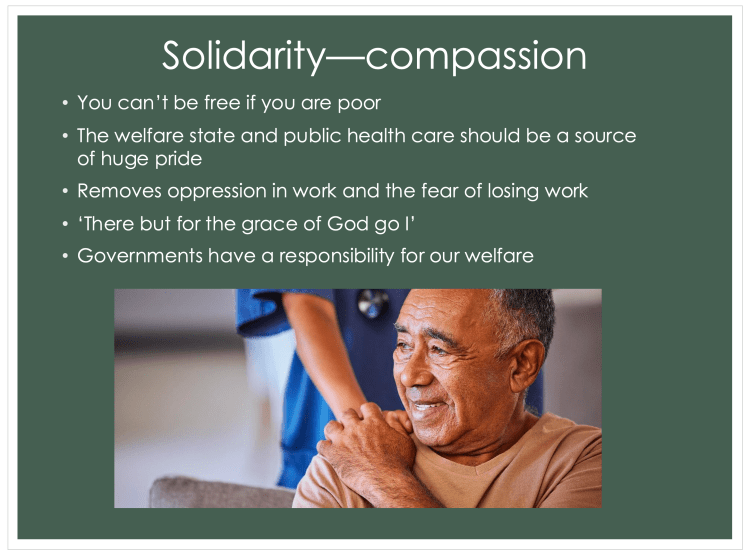
This is another European value that is included in the official list, and I think is really important to gain in contrast to what happens in the US. I think the sense of solidarity and compassion for your fellow citizens is a very European value, something I’ve always felt very proud of. This has been a sort of value that was instilled in me from my childhood, and I think I think it’s a very European value and something that sets our continent apart from the other continents, because it’s all very well saying you’re free, but actually if you’re in poverty, what is that freedom or worth? You can’t be free to operate as a human being if you’re living in poverty. And that’s why we have the commitment to the welfare state and to public health. You know, not all European countries have a national health service like we do, but it’s completely distinct from most countries of the world where if you’re poor, you’re frightened that you won’t be able to afford healthcare, which to me is just a moral obscenity. And I think we should be very proud of that.
We should be very proud of the fact that we support our citizens when they have hard times or when they have health issues. And it removes that fear. It’s a sense of a safety net and removes that sense of oppression in work. To me, this is all about solidarity, is all about that sense of ‘there, but for the grace of God, go I’. We’re all going to end up, if we’re lucky enough to live long enough, we are all going to end up claiming benefits, because we’ll be claiming a pension. So we have to respect the fact that there are times when we all need that help.
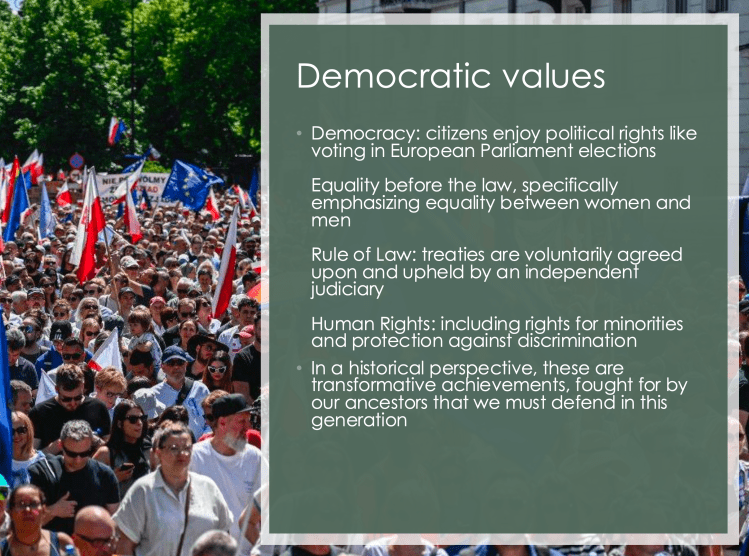
Democratic values are so timely and so important, and in fact, it’s so difficult to define exactly what we mean by democratic values, because there’s obviously so much more than voting. But voting is basic. Citizens enjoy political rights in Europe, such as voting in European Parliament elections, and in national elections. We could have a conversation about how free and fair our elections are under the existing electoral system. But certainly the right to choose those who represent you is a crucial right. Equality before the law is also extremely important and specifically this part of the article does emphasise the importance of equality between women and men. We’re hearing a lot of conversation at the moment about the rule of law, and that’s a very bad sign because when we’re all operating comfortably under the rule of law, we don’t think about that.
But when threats come to the rule of law, then you start to realise how important that is, and treaties between countries are agreed upon voluntarily, and upheld by an independent judiciary. Obviously, the independence of the judiciary is coming under massive threat in the US at the moment, but also in this country, we’ve seen politicians just basically denigrating the rule of law. So the rule of law is under threat in our country, but I think the need, the requirement for politicians to abide by the rule of law is something that we see strongly as a European value.
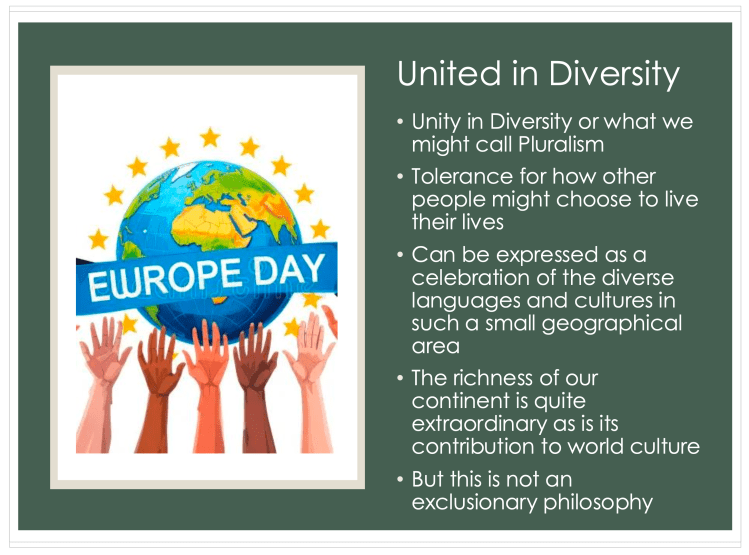
Similarly with human rights, rights for minorities, and protection against discrimination. These are upheld by European institutions, and I think taking these rights as a whole, in historical perspective, they are transformative achievements for humankind. They’ve been fought for by our ancestors, and it’s vital that we defend them in this generation, and that we celebrate them as being something that typifies the continent we’re part of. So, I’m sure members of the European Movement will know that the slogan, as it were, of the European Union is, is actually ‘united in diversity’ or ‘unity in diversity’ which we can also think of as being about pluralism. Respecting other people for being the way they are, tolerance for how other people choose to live their lives.
One of the things that makes me immensely proud about being a European is just the incredible diversity of culture and languages that we have in this country. And again, in my life as an academic, I met a lot of US academics, and the more thoughtful, self-reflective ones would just say sometimes, it’s just astonishing. There you are all getting on with each other, you know, with your different languages, you will speak a bit of each other’s languages. Because, as we know, most citizens of the US only speak English and expect other people to speak English. I know Brits can be a bit like that, but hopefully we’re improving. So to me, that’s something to be immensely proud of, just the diversity of culture and languages and the way we all respect and value each other’s culture and languages.
The richness of our continent is quite extraordinary, as is our contribution to world culture. I’m sounding a bit nationalistic now, but probably get away with it because I’m being nationalistic on behalf of a continent and in a good cause. And it’s also important to say this is not an exclusionary philosophy. I’m not saying European culture’s great because other cultures aren’t great. And that’s why it’s important to recall that there was a time when the Americas were the beacon.
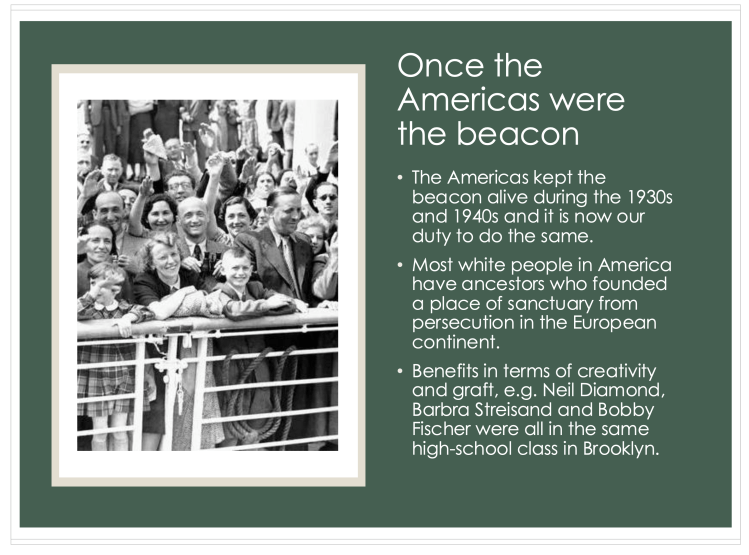
During the time when fascism, the last time fascism was so dominant in Europe, it was in America that the beacon of human rights, and democracy, and respect for the rule of law was kept alive during the 1930s and 1940s. This is just one of the many ships that took Jewish refugees to safety and sanctuary in the US. For so many Americans, the US was a place of sanctuary, whether it’s sort of 19th century Russian pogroms, or, escaping Germany under Hitler, or even longer ago, the original immigrants who left religious persecution in Europe. The US was a place of sanctuary for so many people, and I really wish more progressive politicians in the US were to feel proud of that, because I feel proud when European countries give sanctuary to people fleeing war and persecution and climate change increasingly.
But when Europe failed, the US was there, giving sanctuary to people. So although I am setting this up as a bit of a competition, it’s important to remember that there was a time when we were definitely losing this competition. Something I learned recently was that Neil Diamond and Barbara Streisand and Bobby Fischer were all in the same high school class in Brooklyn. So the consequence of allowing in these Jewish refugees was incredible creativity. Cultural creativity. It’s not just about entrepreneurship and money making, although obviously that’s a part of it, but just, If you think about the culture of the US without what refugees brought in, it would be so diminished, and the same is true of our country.
So, this is my basic message: Europe is not broken. I think we’ve all fallen into increasingly what is Reform propaganda and far right propaganda. ‘Britain is broken’, which is a far-right meme that we should use because it feeds the rise of fascism. Yes, we wish there was more investment in our public services, but that does not equate to our society is broken. European societies are not broken. We are living better lives now than we’ve ever lived. Obviously, there’s greater inequality, and that’s something where our politicians are failing, but we have longer lives, happier lives, and lives where we tolerate each other more than we ever have in the past.
And obviously, as a Green, I’m concerned that we’re not respecting the principle of sustainable development, which is another European value, and at the end of the growing inequality of wealth and power. But I don’t think we should allow those things to undermine our confidence in what a marvellous continent we are part of. And let’s not allow this propaganda against Europe and against the democratic society we live in to overwhelm our confidence and our sense of pride.
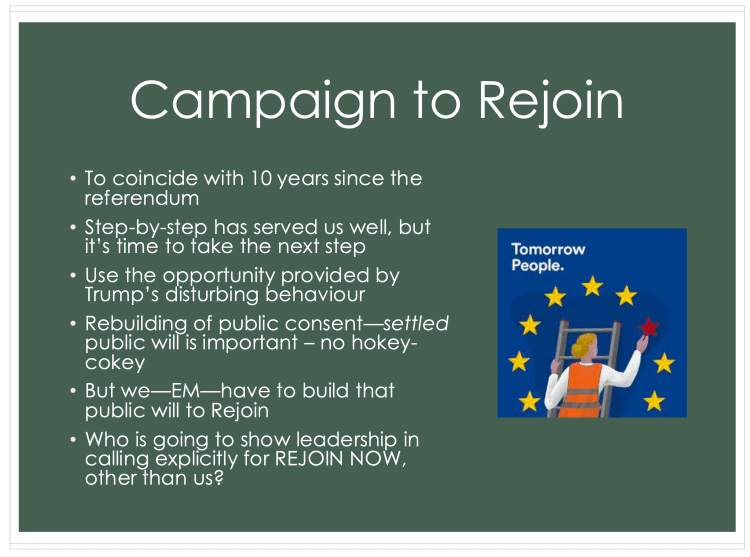
And this is where I’m going to conclude, because this is my challenge to you really. And this is also my challenge to the European Movement. The 10-year anniversary coming along is the time for us to come clean and say we’re all about rejoin. We’ve been so battered down by all the Brexit omerta we’ve lose our confidence. We need to just put all that to one side. It’s ten years on. We can see the disaster that Brexit has been in so many ways. It’s time to be very clear that actually what we’re about is rejoin, and start campaigning actively. There’s a sort of unwillingness to show leadership. We know that not everybody agrees we should rejoin, but that’s our job, right? To convince those people and build that secure two-thirds majority that we need.
The step-by-step strategy has served us well, but it’s time for us as a movement to take the next step, and that next step is to come out very clearly and say we are for rejoining the European Union. We need to rebuild that public consent. The settled public will is really important because the main reason the EU will say no is because if they see there’s a possibility of us having a government that will want to take us out again because that’s just so destabilising. But I have to say that the destabilisation, whether you think about Hungary or whether you think about the far right movements in some of Europe’s leading countries now, the EU’s leading countries.
I think, you know, they’re going to have to get a little bit less sniffy about the fact that we’ve got Nigel Farage. Because all countries in Europe now, I’m very sad to say, have a far right, or as I would see it, a fascist party on 20% plus. So we’re no different there. We, as the EM, in my view, as the European Movement, have to build that public will that we join because if it’s not us that’s showing that leadership, who is going to? So that’s why I’ve got capital letters there. I do think it’s time to rejoin now and who is going to argue that other than us? Thank you very much.
 European Movement in Wandsworth and Merton